Tools
FigJam
Figma
Figma Slides
Responsibilities
UX Research
Project Management
Presentation & Pitch
Timeline
8 hours
Designathon
November 2025
Collaborators
Mavis Lo
Mackenzie Leu
Andreea McKague
Flock
A platform to deliver genuine and impactful mentorship in a supportive community. Reimagining growth through small, meaningful moments.
Second Place!
A look at modern mentorship
We were challenged to design a solution to the hyper-individualism crisis in modern society, to help people connect with and care for each other and their communities.
How can we design solutions that help people care, connect, and thrive, empowering both individuals and community?
In trying to identify a problem without a digital solution that already exists, we considered issues from healthcare to indigenous rituals. However, due to the tight timeline, I knew we wouldn't be able to achieve a deep enough understanding of user needs to create a well-researched solution.
Then, I had a crucial revelation: we were working in a unique environment, surrounded by a blend of students and mentors, a user base that we could properly research.
Understanding both sides of mentorship
Through research online, we identified an important statistic.
76% of people believe mentors are important yet only 37% actually have one
This revealed a gap in modern mentorship. To uncover more, I took advantage of the gold mine of user data around us and hosted user interviews with mentors and students. I synthesized reccuring pain points into two categories:
Scheduling & time commitment
Recurring 1:1s felt like a heavy obligation, fitting two busy schedules together becomes impossible
Friction finding mentors
Compatibility, fear of judgment, and hidden resources keep connections from being made.
I expected mentor engagement to be the biggest challenge. Instead, mentors were highly willing to give back. Instead, the friction came from scheduling, structure, and maintaining connections.
Two distinct user journeys
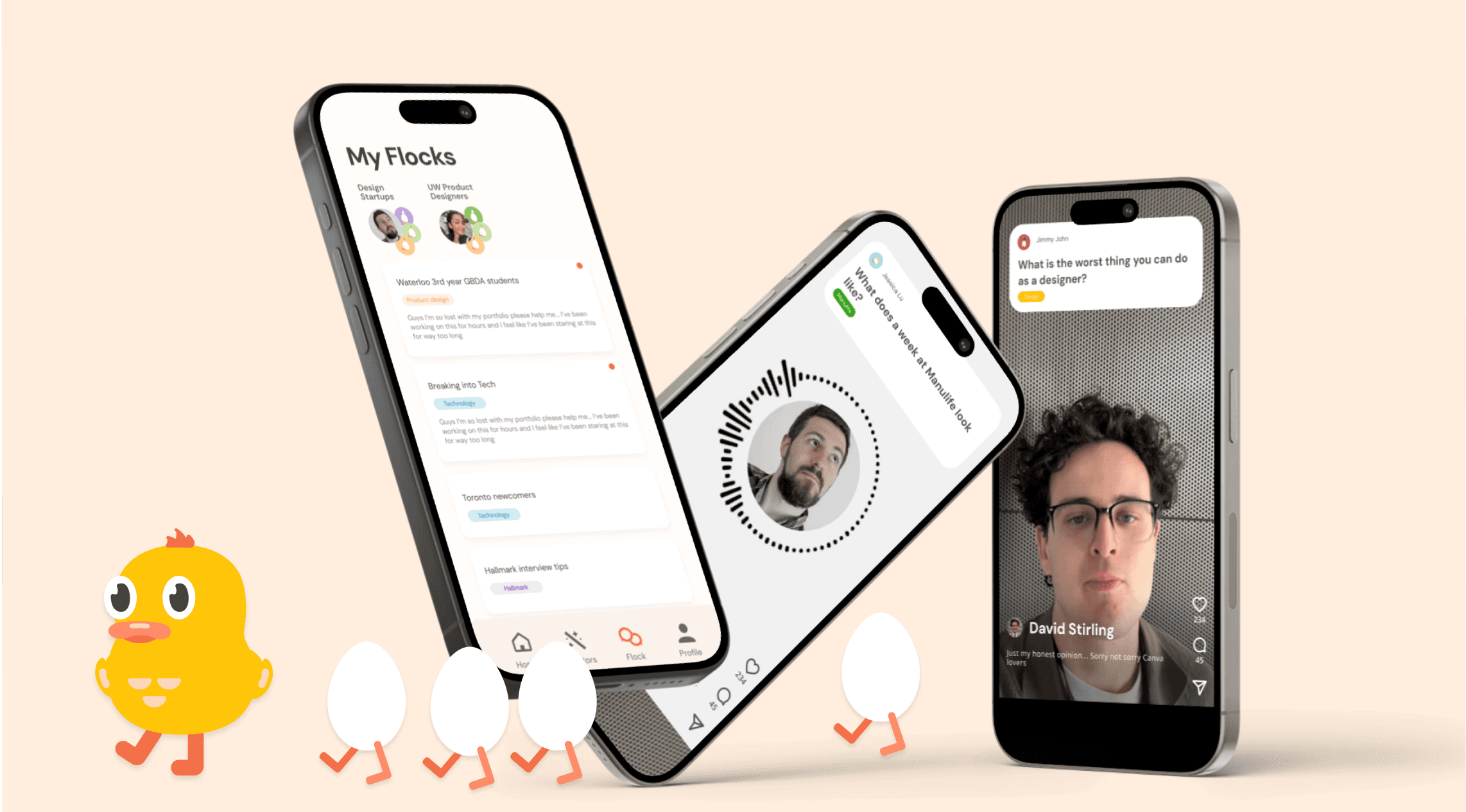
Flock was born from a need for authentic connection between students and mentors, and a community of mutual growth and respect. Mentees can join multiple Flocks, or communities following one mentor. Mentors tend to their Flocks, answering questions and moderating interactions.
Through our role-based onboarding, Flock is split into two experiences. We felt it was important to establish two distinct user flows to accommodate two distinct needs.
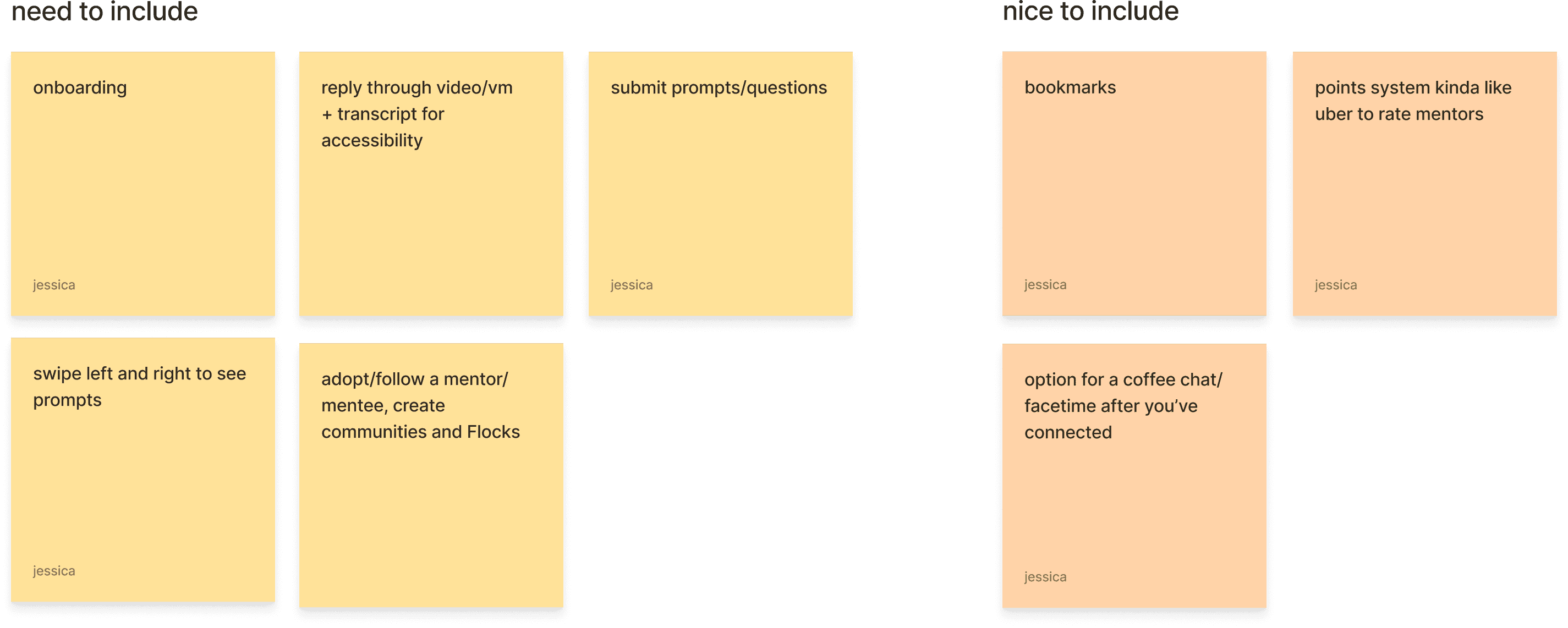
In order to streamline each flow, I organized our ideas to identify only the non-negotiable features, preventing cognitive overload and ensuring full coverage of pain points.
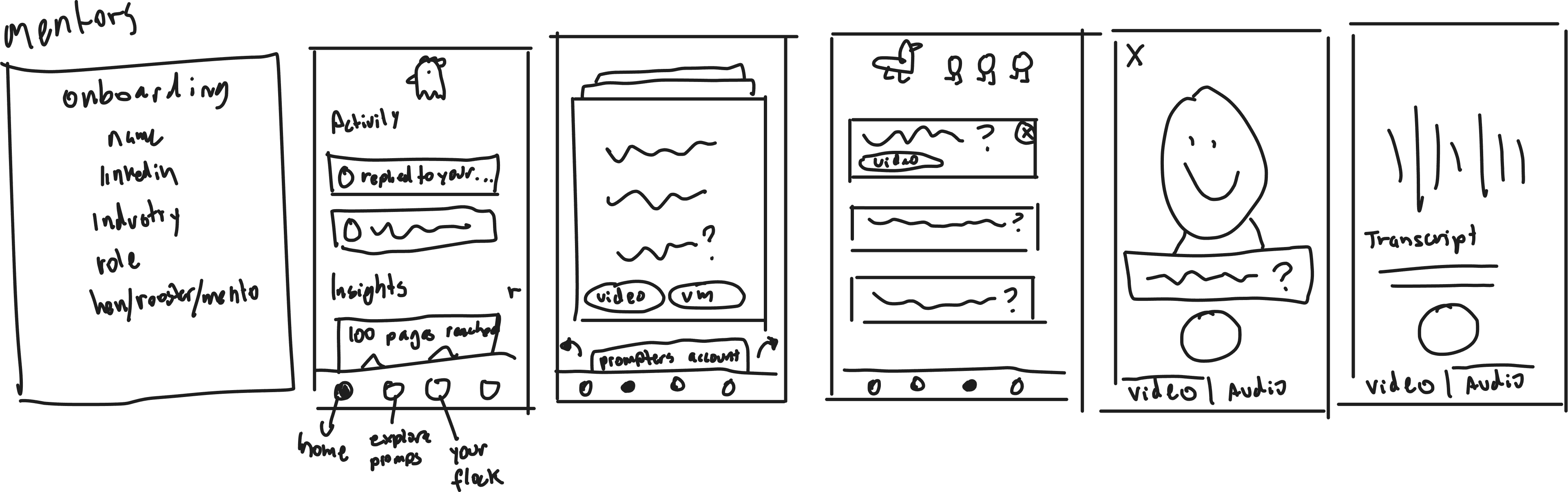
Key points for mentors are flexibility and feeling like they're making an impact.
How we addressed each pain point:
Time commitment
Async communication allows mentors to give deeply on their own time, without committing to a schedule. Mentors can adjust how much they give based on their needs.
Friction finding mentors
Flocks allows eager, like-minded students and beginners to find mentors through industry and interest tags on profiles, removing the tedious and stressful early stages of finding mentorship and streamlining to the growth.
Mentors (Hens)
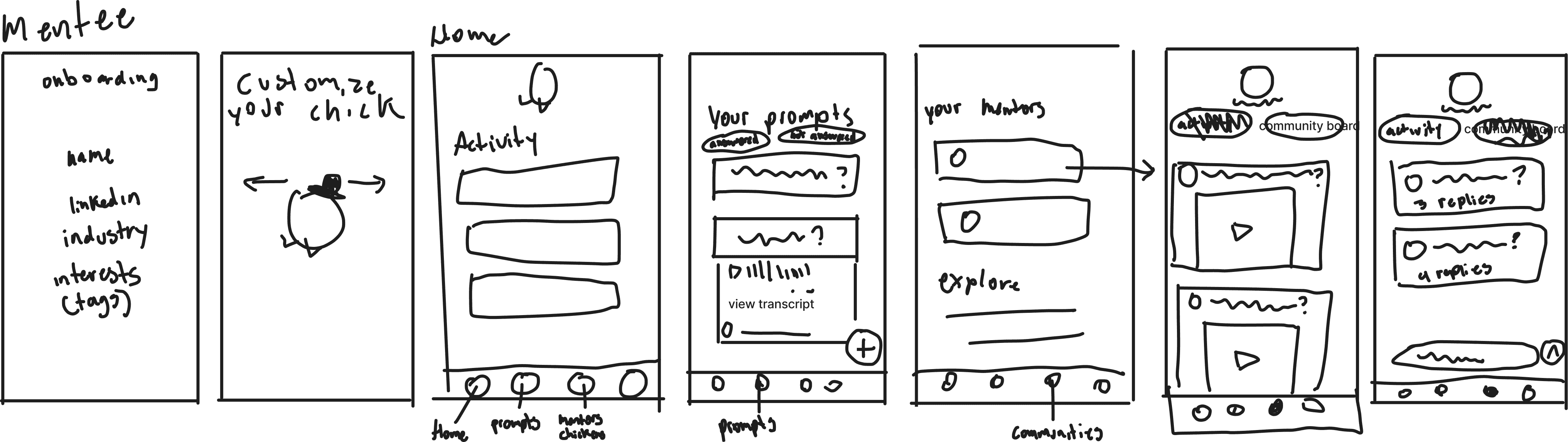
Key points for mentees are accessibility, community, and feeling welcome. Because of power imbalances and age differences, we also wanted to prioritize building a safe platform for mentees to thrive.
How we addressed each pain point:
Time commitment
Mentees interact with their mentors on their own time, sending in questions to be answered. However, they have unlimited access to their Flocks, allowing learners to support each other even between mentor responses.
Friction finding mentors
Through the detailed onboarding and algorithm, mentees can easily find new mentors and join new Flocks, based on compatible industries and interests. The anonymous user profiles remove mental blocks such as fear of judgment.
Mentees (Hatchlings)
Cards, video, and community boards (and chicken?)
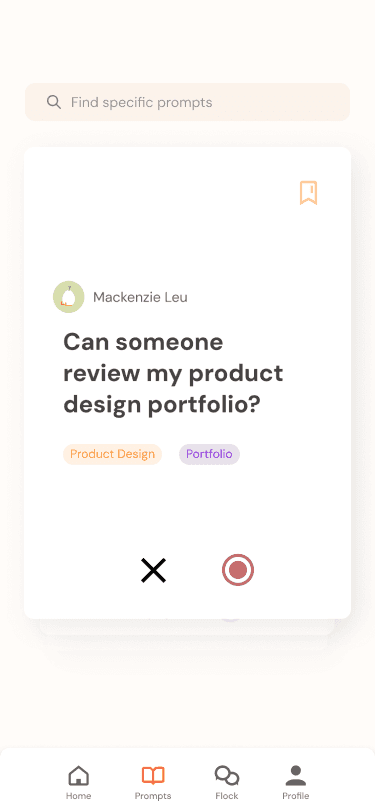
Card swipe system
Mentors browse questions from their mentees (without feeling like doomscrolling!).
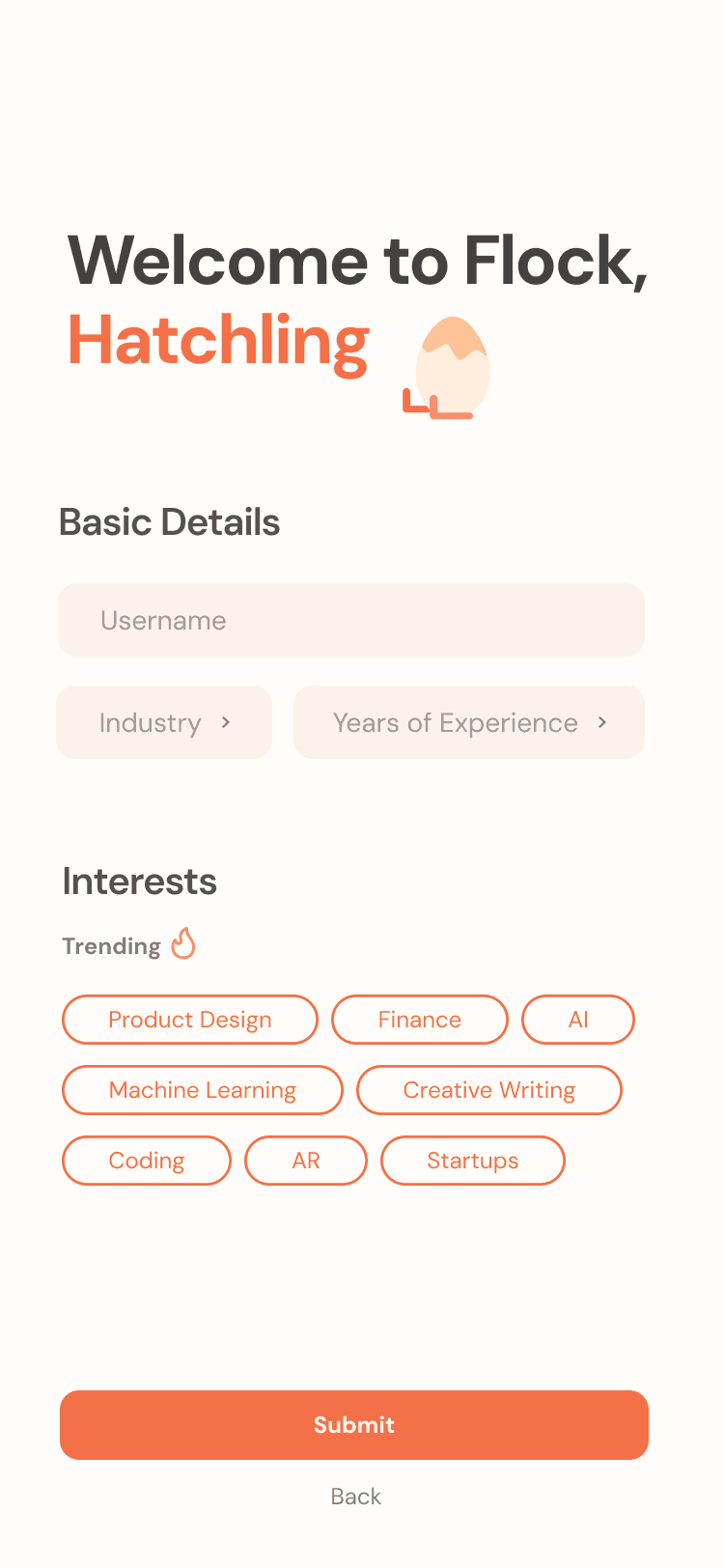
Onboarding
Personalize settings for the algorithm. We decided to use anonymous profiles to preserve safety.
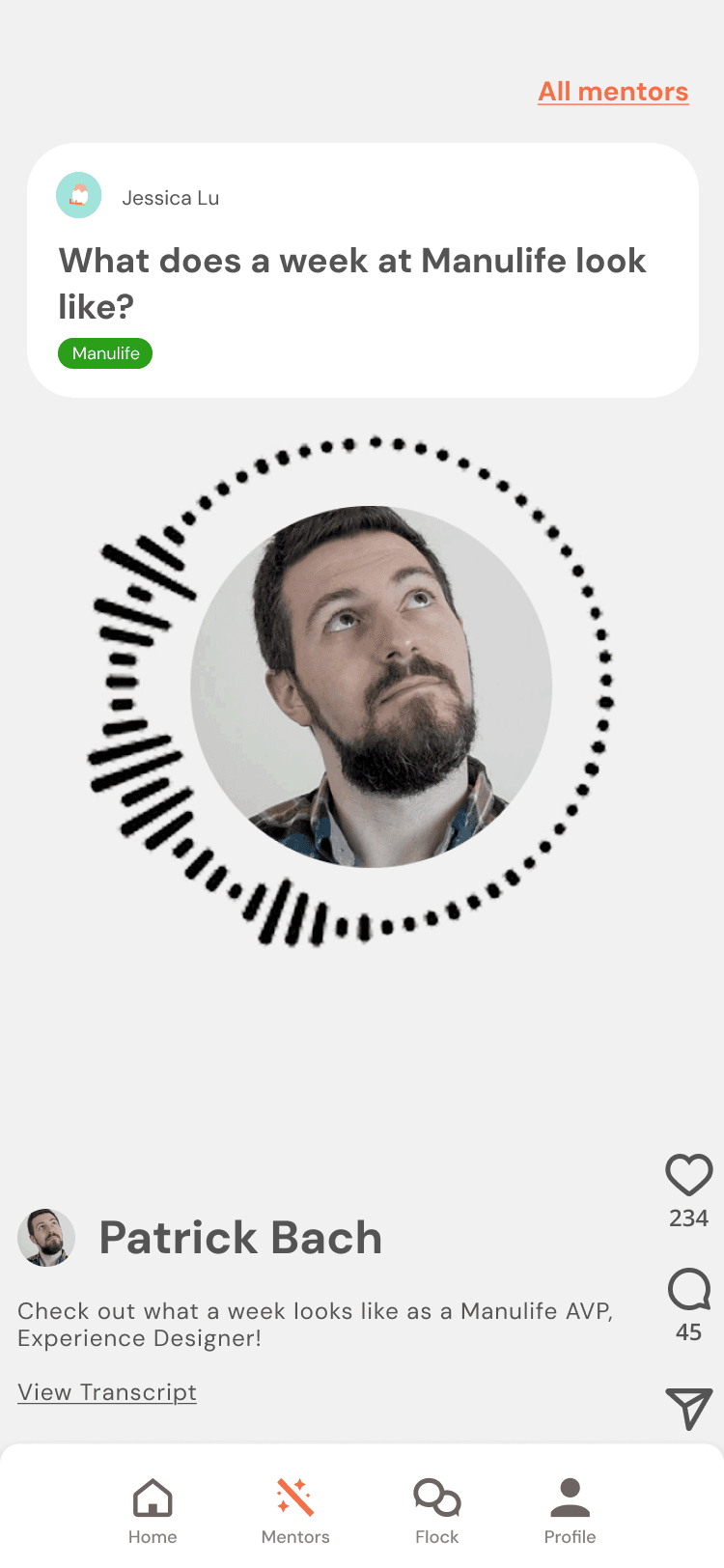
Video & audio responses
Maintaining the authenticity of face-to-face conversation.
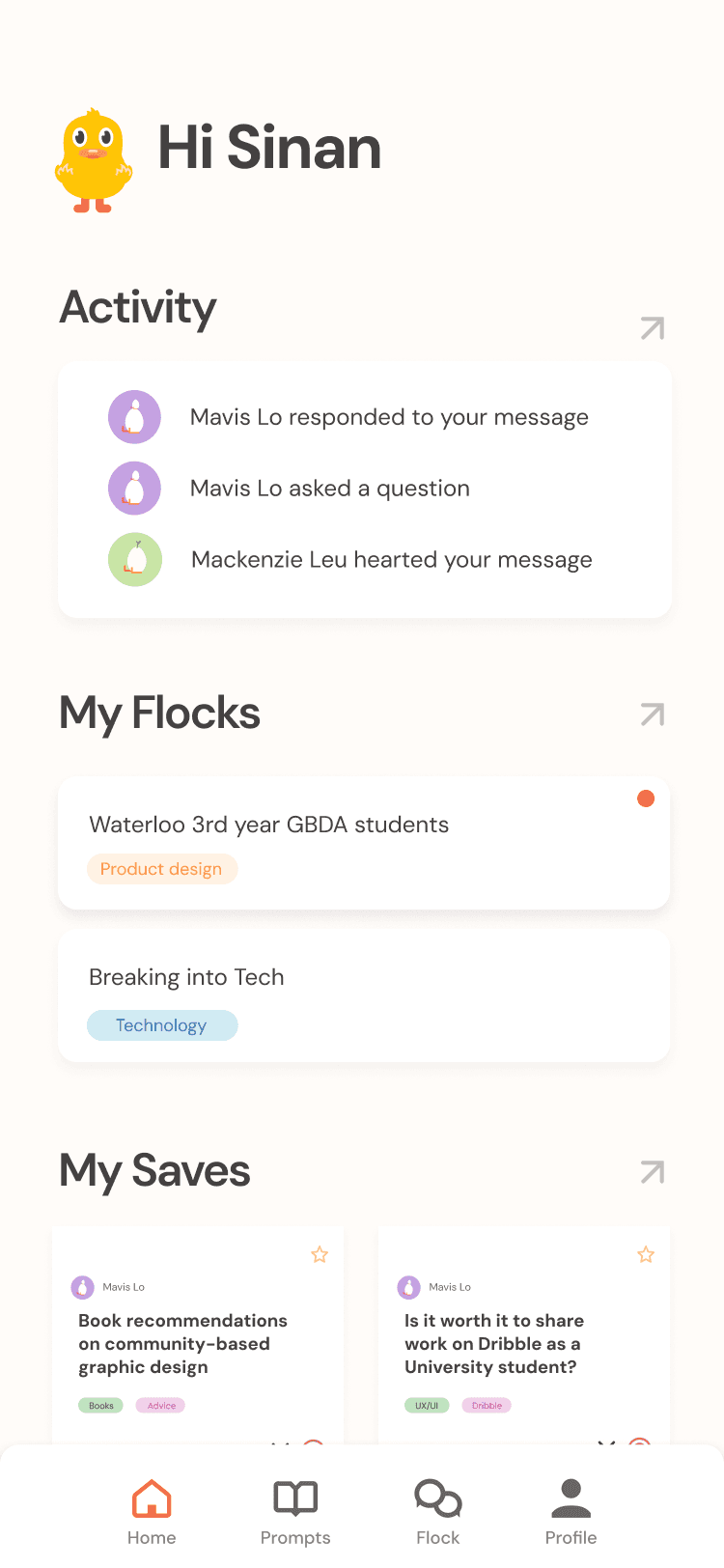
Dashboard
Gain insights on Flocks, activity, and impact all in one easy-to-use page.
Building an app centered around community and growth, we wanted to give our app a face that was friendly and welcoming. I thought of a chicken to represent guidance and care, eggs to represent growth, and a flock to represent community. I designed customizable hatchlings, while a teammate designed the chicken, and Flock made its way to the screen.
Mentor flow
Mentee flow
04
Final
What I'd carry into the next project
Trusting your team is a design decision too
With only 8 hours to complete this project, I didn't have room to doubt my team. For us to succeed, I had to do my part well and trust that they would too, while communicating and ensuring we were all an the same page. It proved to me that collaboration is one of the most important skills a designer should have.
The UX behind the UI
Wanting to challenge myself, I focused on management, research, interviews, and the slide deck during this project. The insights from my research and interviews gave my teammates a clear brief. The slides made the short presentation actually land. UX work for this project meant building a solid foundation to create, and then selling it to a room full of judges. I want to get better at both ends, and eventually connect them to be a fully rounded designer.
05
Takeaways